Begin with 「道」 — the Way
If you’re new to Daoism, you don’t need to learn a long list of unfamiliar words before you begin. Let’s start with just one: 「道」 (Dao), usually translated as “the Way.” You may also see the spelling Tao, and Taoism for Daoism. These are different ways of writing the same Chinese words in English.
In Daoist understandings, 「道」 is the source of all things and the underlying way the world unfolds. A tree putting out new leaves, the seasons turning, our own lives changing: we are part of that larger world, too. These everyday scenes can help us begin to think about the idea, even though no single example captures everything 「道」 means.
For now, try a simple question: How do I live as part of the world around me? You don’t need a perfect answer. Having the question is a good place to start.
「道家」 and 「道教」 — two ways into a tradition
You’ll often meet two related terms. 「道家」 (Daojia) is commonly used for philosophical traditions associated with thinkers such as 「老子」 (Laozi) and 「莊子」 (Zhuangzi). 「道教」 (Daojiao) usually refers to Daoist religious traditions: their scriptures, deities and immortals, rituals, communities, and teachings passed from teachers to students.
These labels are helpful starting points, but the histories of thought, belief and practice are closely intertwined. Reading a classic is one doorway; learning how people worship, gather and practise is another. If you visit a Daoist temple, the ideas on the page may begin to feel less distant.

A tradition that took shape over time
Daoism grew within Chinese culture, drawing together older worship of gods and spirits, beliefs about immortals, practices for nourishing life, and Daoist thought. Its history is a gradual gathering of traditions, rather than a single moment when everything appeared at once.
In the Eastern Han period, 「張道陵」 (Zhang Daoling) and the early 「天師道」 — the Way of the Celestial Masters — are important starting points for understanding organised Daoist communities. Across later centuries, people collected scriptures, developed rituals and passed on teachings. That long history helps explain why Daoism has so many forms today. Explore the history in more detail.
「陰陽」 — noticing relationships and change
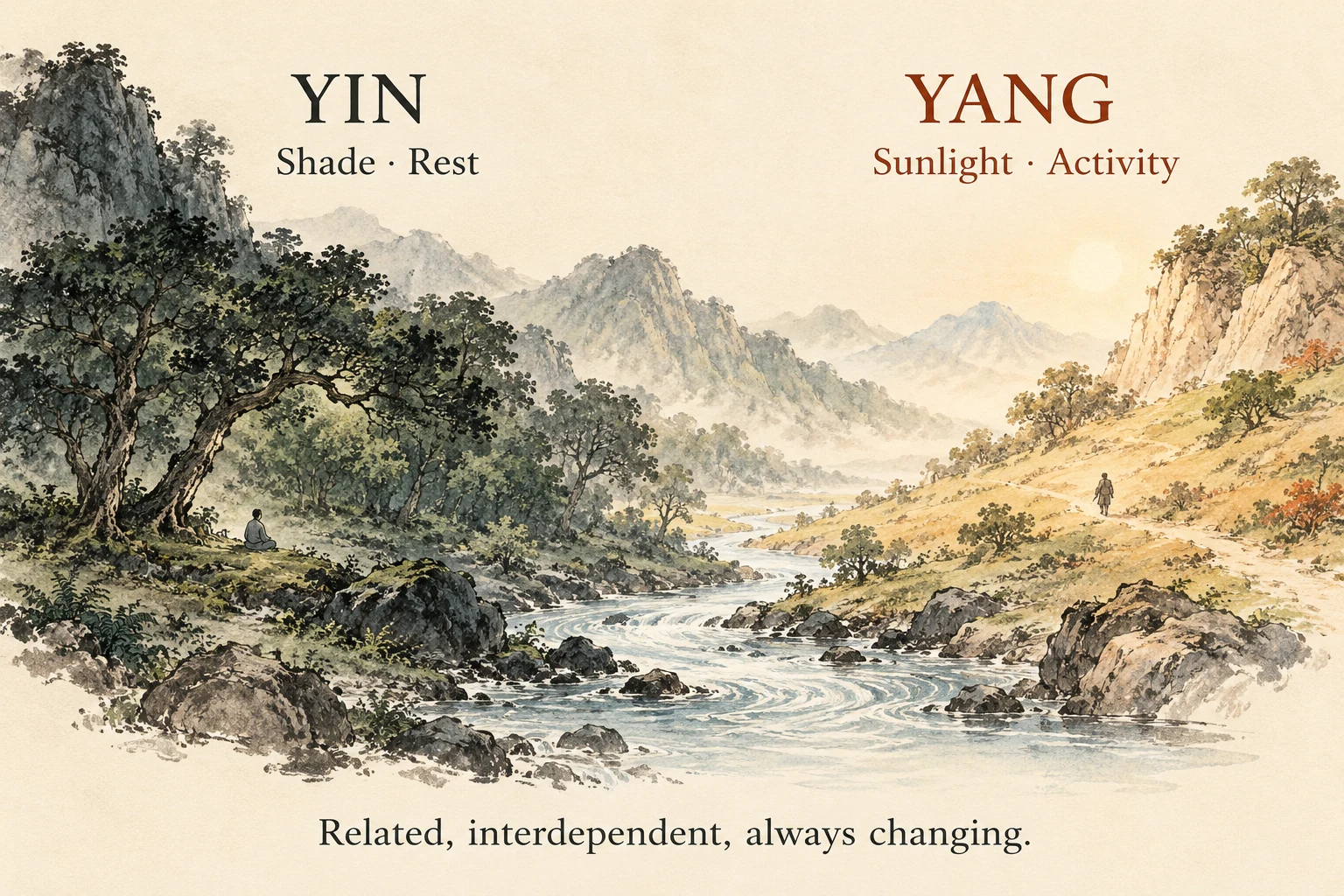
「陰陽」 (yin and yang) describes related, interdependent aspects of things. The shady and sunny sides of a hill offer a useful first picture. So do night and day, or rest and activity. Each makes sense in relation to the other, and the situation changes with time.
Think of a busy day. There are moments to get moving and moments to pause. Neither activity nor rest is always the right response; what fits depends on the circumstances. This everyday example is a way into the idea, rather than a rule for labelling every experience.
「陰陽」 is not a battle between good and evil, and harmony doesn’t always mean equal amounts of two things. Start by noticing how different parts of a situation depend on one another.
「五行」 — a traditional language of connections
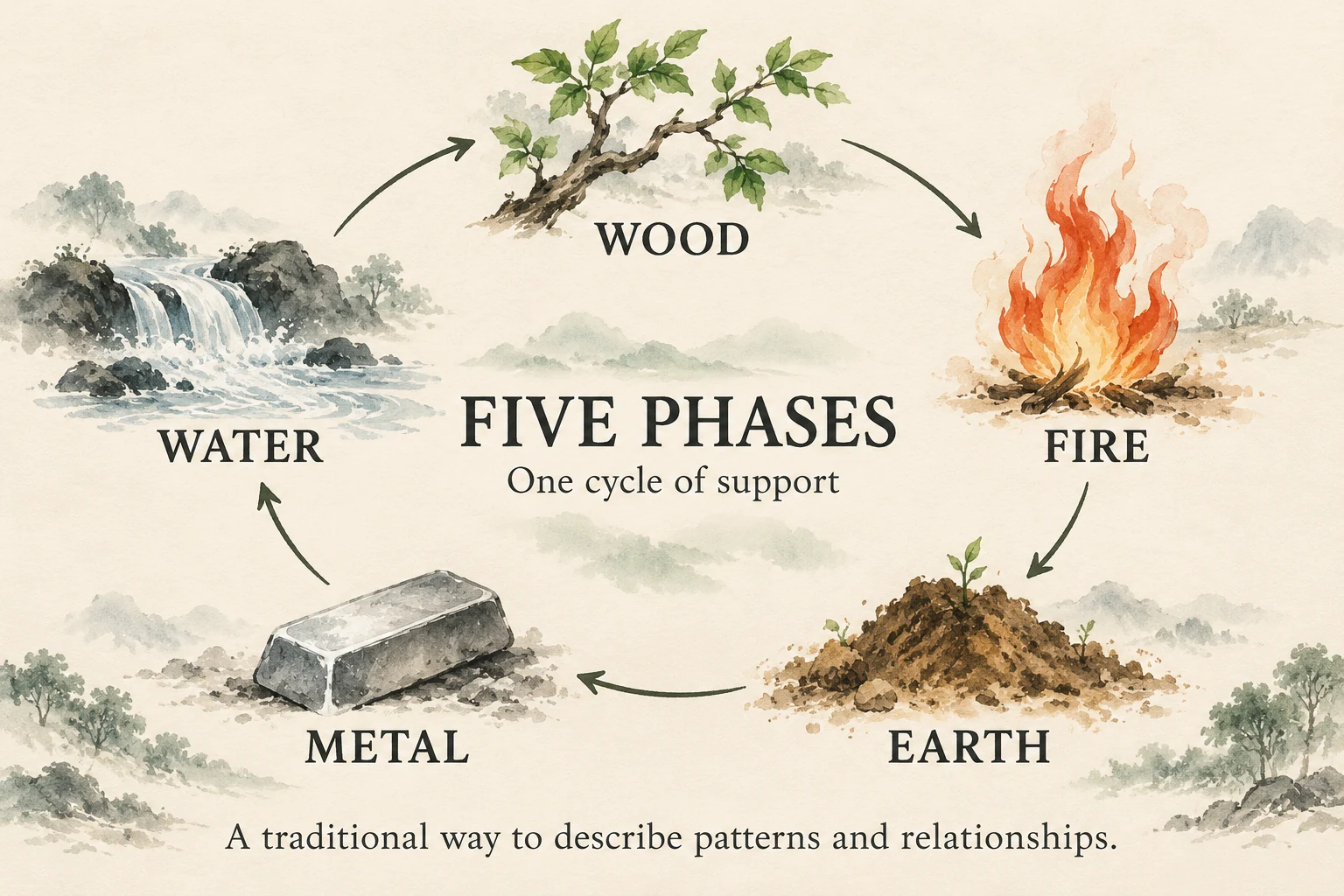
「五行」 (wuxing) means the Five Phases: 「木」 (wood), 「火」 (fire), 「土」 (earth), 「金」 (metal) and 「水」 (water). You may also see “Five Elements.” Here, “phases” is a useful reminder to think about patterns, activities and relationships, rather than five chemical ingredients.
In this traditional framework, wood can be associated with spring and growth. Other connections link the phases with qualities and changes across the world. These ideas belong to a wider Chinese intellectual tradition and are also used within Daoism.
Two useful terms are 「相生」 — supporting or generating — and 「相克」 — checking or regulating. The illustration shows just the generating cycle: wood → fire → earth → metal → water → wood. It is one part of a larger framework, not the whole system. You can learn the detailed correspondences later; first, notice the emphasis on how things relate and change.
「自然」 and 「無為」 — learning how much to do
In Daoist thought, 「自然」 (ziran) suggests being “so of itself”: things unfolding according to their own character. It is often translated as naturalness or spontaneity. The word reaches beyond the modern English idea of nature as the outdoors.
「無為」 (wuwei) is often translated as “non-action.” A friendly way into it is to think about acting without unnecessary forcing: paying attention to the conditions, instead of pushing everything towards what you want. It asks for discernment, rather than simply sitting back and doing nothing.
Picture caring for a plant. You water it, tend the soil and make sure it gets suitable light. You also give it time. Pulling on the stem won’t help it grow. This is our everyday analogy, not a quotation from a classic: care, patience and knowing when to stop can belong in the same action.
Begin with how you treat people
「修行」 (xiuxing) means cultivation or practice. In Daoist life, it can involve much more than reading about ideas. For a first reflection, though, you can begin close to home: be a little more honest in what you say, make room for patience when you disagree, and notice when wanting more has stopped being helpful.
Then return to a classic or a story about Daoist immortals and practitioners. It may feel different when you bring a little lived experience to it. These small reflections are not a complete account of religious training; they are a gentle way to begin paying attention.
You don’t have to understand everything today. Start with one word, one question, or one ordinary moment. There is room to learn slowly.
Sources and a next step
This introduction follows the Chinese text prepared for Auspicious Dao, with added explanations and everyday examples for English-speaking beginners. Daoist communities and scholars do not explain every term in exactly the same way. For a deeper look, explore the Stanford Encyclopedia of Philosophy on Daoist religious traditions and Laozi, naturalness and non-action, and the Internet Encyclopedia of Philosophy on yin and yang and the Five Phases.
Keep exploring in the Journal, or meet Auspicious Dao. Bring your questions with you.